





Vol. 28 - Num. 111
Original Papers
Prevalence of breastfeeding in a primary care center in San Fernando de Henares (Madrid)
Blanca Espínola Docio a, Verónica Gómez Hernandoa, Soraya González Martínezb, Davinia Fernández Bonoa, María Herrero Leóna, Olga del Carmen Carmona Abellánc
aPediatra. CS Los Alperchines. San Fernando de Henares. Madrid. España.
bPediatra. CS Valleaguado. Coslada. Madrid. España.
cServicio de Pediatría. Hospital Infantil Universitario Niño Jesús. Madrid. España
Correspondence: B Espínola. E-mail: blanca.espinola@salud.madrid.org
Reference of this article: Espínola Docio B, Gómez Hernando V, González Martínez S, Fernández Bono D, Herrero León M, Carmona Abellán OC. Prevalence of breastfeeding in a primary care center in San Fernando de Henares (Madrid) . Rev Pediatr Aten Primaria. 2026;28:313-21. https://doi.org/10.60147/322d830d
Published in Internet: 16-09-2026 - Visits: 1606
Abstract
Introduction: breastfeeding is the optimal method of feeding infants. Breastfeeding rates in Spain are far from the targets established by the World Health Organization. The primary objective of our study was to determine the prevalence of breastfeeding in our catchment area in children under 2 years of age. The secondary objectives were to determine the prevalence of breastfeeding in the first 15 days of life, at 6 months, and at 1 year.
Methods: descriptive cross-sectional observational study of children aged 0 to 24 months assigned to the Los Alperchines primary care health center in San Fernando de Henares (Madrid). A survey was conducted with a total of 123 children. We collected data on the sociodemographic characteristics of the mother as well as data on the child’s diet by means of the IHAN questionnaire. The statistical analysis was performed with the software SPSS version 26.
Results: the prevalence of breastfeeding in the sample of children aged less than 2 years was 51.35% (95 CI: 44.4-62.8). In addition, 57.6% of infants aged less than 15 days and 51% of all infants aged less than 6 months were exclusively breastfed.
Conclusions: comprehensive efforts are required to meet WHO objectives by adopting measures to promote breastfeeding and support breastfeeding maintenance. Initiatives such as the IHAN project for primary care centers must be supported and recognized by the health authorities.
Keywords
● Breastfeeding ● Prevalence ● Public HealthINTRODUCTION
Breastfeeding (BF) is the optimal method of feeding infants, from a nutritional as well as an immunological and psychological standpoint, with ample evidence of its short- and long-term benefits.1 The World Health Organization (WHO), 2 the European Union (EU),3 and the Committee on Breastfeeding of the Asociación Española de Pediatría (AEP, Spanish Association of Pediatrics)4 recommend exclusive breastfeeding (EBF) through age 6 months and continued BF with complementary feeding with other appropriate foods through age 2 years or longer. Efforts to promote and support breastfeeding have led to an increase in BF prevalence rates in recent years. However, we are still far from meeting the WHO BF targets.5
In Spain, there is no official BF surveillance system. National data on BF are extracted from annual national health surveys (NHSs). In the 2023 NHS, the percentage of EBF at age 6 months was 47%,6 compared to 39% in 2017.7 Studies in several autonomous communities in Spain have yielded heterogeneous figures.8 A study published in 2015 conducted in a primary care center in Zaragoza9 found a prevalence of EBF at 6 months of 15.8%, while the reported prevalence of EBF before 6 months in a basic health zone in Granada in 2017-2018 was 37%.10
Nutrition with human milk is likely the public health intervention that, at the lowest cost, yields the greatest health benefits for the individual.6 The evidence clearly shows that efforts to promote breastfeeding are a worthwhile and profitable investment in a more prosperous future. Health authorities and organizations consider the protection and support of breastfeeding to be a public health and health care priority.
Currently, postpartum stays in the maternity ward are very short, so most BF support interventions take place at the primary care level. Therefore, it is essential that primary care organizations and professionals implement evidence-based practices and measures to support BF.11
This is the objective of the IHAN (“Iniciativa de Humanización de la Atención al Nacimiento y la Lactancia”, the Spanish adaptation of the Baby-Friendly Hospital Initiative of the WHO/UNICEF), with the launch of the IHAN Health Center Initiative.12 Its aim is to ensure that health care centers implement care excellence practices from childbirth to support breastfeeding throughout infancy in order to ensure optimal nutrition during this period. It includes an effective evidence-based training program for health care professionals to enable them to support breastfeeding initiation and maintenance. The first step in this initiative is to study the prevalence of BF in the specific health care center to establish a baseline to allow subsequent evaluation of the impact of implemented measures.
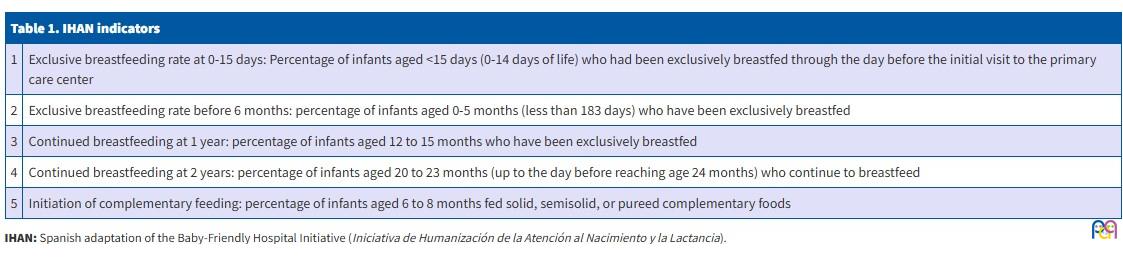
In line with this initiative, and since few studies have been published that measured the prevalence of BF at the primary care level, we conducted a study with the primary objective of determining the prevalence of BF among children aged less than 2 years in the catchment area of our primary care center using the IHAN prevalence survey. The main secondary objectives were to determine the prevalence of BF in the first 15 days of life, before age 6 months, and at 1 year, in addition to the prevalence of EBF in the first 15 days of life and in infants aged less than 6 months, which correspond to the IHAN indicators (Table 1). Other secondary objectives were to analyze the reasons for never BF and BF discontinuation, the participation in BF workshops, and the factors associated with BF maintenance at age 6 months.
| Table 1. IHAN indicators | |
|---|---|
| 1 | Exclusive breastfeeding rate at 0-15 days: Percentage of infants aged <15 days (0-14 days of life) who had been exclusively breastfed through the day before the initial visit to the primary care center |
| 2 | Exclusive breastfeeding rate before 6 months: percentage of infants aged 0-5 months (less than 183 days) who have been exclusively breastfed |
| 3 | Continued breastfeeding at 1 year: percentage of infants aged 12 to 15 months who have been exclusively breastfed |
| 4 | Continued breastfeeding at 2 years: percentage of infants aged 20 to 23 months (up to the day before reaching age 24 months) who continue to breastfeed |
| 5 | Initiation of complementary feeding: percentage of infants aged 6 to 8 months fed solid, semisolid, or pureed complementary foods |
MATERIAL AND METHODS
We conducted a cross-sectional observational and descriptive study at the Los Alperchines primary care center in San Fernando de Henares, which serves a catchment population of 18 807 users in a predominantly urban area of Greater Madrid.
The sample consisted of children aged between 0 and 24 months assigned to the primary care center. The exclusion criteria were family refusal to participate in the survey or the presence of language barriers that impeded communication.
For a study universe of 200 children, a 95% level of confidence, a margin of error of ±4.5%, and a documented breastfeeding prevalence of 37%,10 we obtained a sample size of 137 children. With the aim of obtaining more accurate information on the prevalence of BF in the first 15 days of life, we distributed the sample into 26 infants aged 0 to 14 days and 111 children aged 15 days to 24 months, according to the initiative indicators.
For infants aged less than 15 days, the data were collected face-to-face when the family made the initial visit to the primary care center 48 to 72 hours after hospital discharge. For the subset aged 15 days to 24 months, they were collected via a telephone interview with the mother or primary caregiver (if it was not the mother). Participants were selected by simple random sampling. The data were collected between November 2024 and April 2025.
The interviews were conducted by primary care center staff (midwives and pediatricians), who had been trained in advance to ensure consistency in data collection.
Study variables
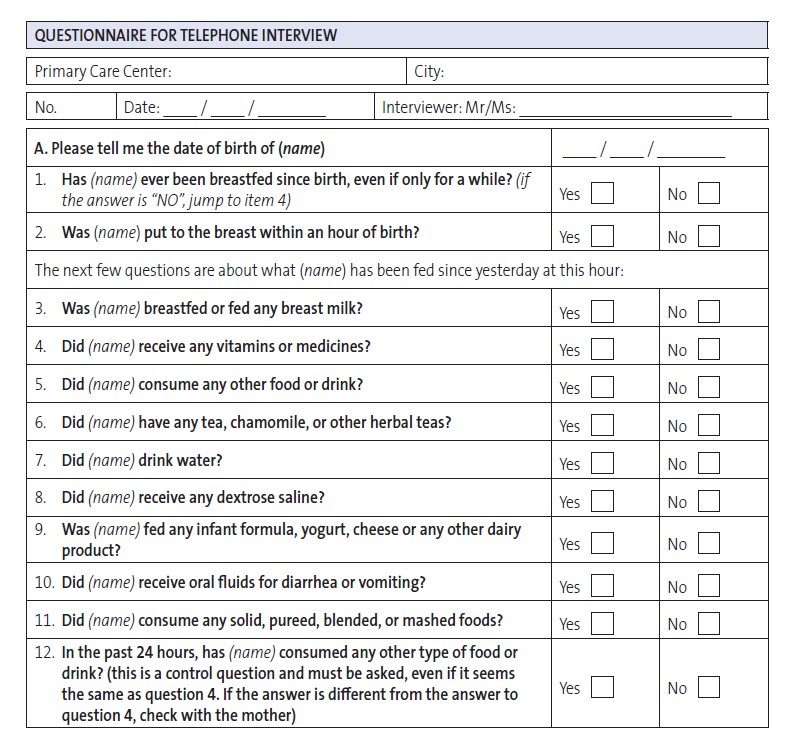
We documented variables selected based on the IHAN survey form (Figure 1). We also collected data on maternal sociodemographic characteristics (age, educational attainment, employment status, country of origin, number of previous children) and mode of delivery. Participants were asked about the reasons why they did not begin or why they stopped breastfeeding, as applicable.
| Figure 1. IHAN survey |
|---|
 |
Statistical analysis
The data were analyzed with the statistical software package SPSS version 26.
Continuous data were summarized as mean and standard deviation, and qualitative data as absolute and relative frequencies.
We calculated the prevalence of breastfeeding and exclusive breastfeeding at different ages as point estimates with the corresponding 95% confidence intervals (CIs). To calculate the prevalence of breastfeeding in the total population aged less than 2 years, we applied a weighting factor between the 0 to 14 days group and the 15 days to 2 years group.
The reasons for not initiating breastfeeding and for breastfeeding discontinuation were described in terms of absolute and relative frequencies.
We conducted a bivariate analysis to identify the factors associated with continued breastfeeding using the chi-square test.
Ethical and legal aspects
The study was evaluated and approved by the Southeast Local Research Commission of the Primary Care Administration of the Community of Madrid. All participants were informed about the study verbally, and those mothers and/or caregivers who decided to participate provided tacit consent to participation by completing the questionnaire.
RESULTS
In the group aged 15 days to 24 months, 14 (11.3%) participants did not respond. In the group aged 0 to 14 days, the response rate was 100%. The final sample included 123 children: 26 infants aged 0 to 14 days and 97 aged 15 days to 2 years.
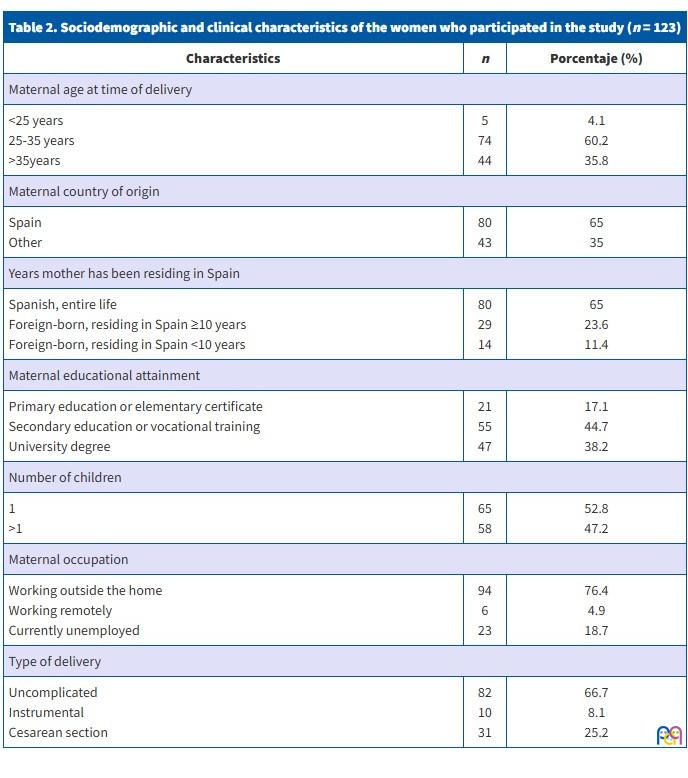
Table 2 presents the data on the sociodemographic characteristics of participating mothers and the type of delivery.
| Table 2. Sociodemographic and clinical characteristics of the women who participated in the study (n = 123) | ||
|---|---|---|
| Characteristics | n | Porcentaje (%) |
| Maternal age at time of delivery | ||
| <25 years 25-35 years >35years |
5 74 44 |
4.1 60.2 35.8 |
| Maternal country of origin | ||
| Spain Other |
80 43 |
65 35 |
| Years mother has been residing in Spain | ||
| Spanish, entire life Foreign-born, residing in Spain ≥10 years Foreign-born, residing in Spain <10 years |
80 29 14 |
65 23.6 11.4 |
| Maternal educational attainment | ||
| Primary education or elementary certificate Secondary education or vocational training University degree |
21 55 47 |
17.1 44.7 38.2 |
| Number of children | ||
| 1 >1 |
65 58 |
52.8 47.2 |
| Maternal occupation | ||
| Working outside the home Working remotely Currently unemployed |
94 6 23 |
76.4 4.9 18.7 |
| Type of delivery | ||
| Uncomplicated Instrumental Cesarean section |
82 10 31 |
66.7 8.1 25.2 |
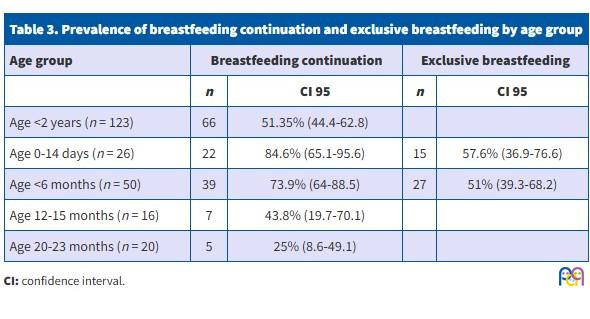
The overall prevalence of breastfeeding among children under 2 years in our study was 51.35% (95% CI: 44.4 to 62.8). The prevalence in infants aged 0 to 14 days was 84.6%, and 57.6% of this subset was exclusively breastfed. Table 3 summarizes the prevalence of breastfeeding and exclusive breastfeeding in the age groups under study.
| Table 3. Prevalence of breastfeeding continuation and exclusive breastfeeding by age group | ||||
|---|---|---|---|---|
| Age group | Breastfeeding continuation | Exclusive breastfeeding | ||
| n | CI 95 | n | CI 95 | |
| Age <2 years (n = 123) | 66 | 51.35% (44.4-62.8) | ||
| Age 0-14 days (n = 26) | 22 | 84.6% (65.1-95.6) | 15 | 57.6% (36.9-76.6) |
| Age <6 months (n = 50) | 39 | 73.9% (64-88.5) | 27 | 51% (39.3-68.2) |
| Age 12-15 months (n = 16) | 7 | 43.8% (19.7-70.1) | ||
| Age 20-23 months (n = 20) | 5 | 25% (8.6-49.1) | ||
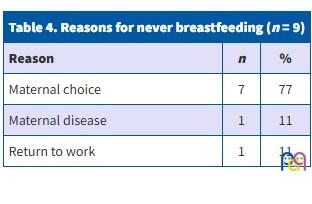
In the study sample, 7.3% of mothers chose not to breastfeed. The main reason given by mothers was their own preference on account of past bad experiences with breastfeeding (77.8% of cases). Table 4 presents the reasons for not initiating breastfeeding. Table 5 presents the reasons for breastfeeding discontinuation.
| Table 4. Reasons for never breastfeeding (n = 9) | ||
|---|---|---|
| Reason | n | % |
| Maternal choice | 7 | 77 |
| Maternal disease | 1 | 11 |
| Return to work | 1 | 11 |
| Table 5. Reasons for breastfeeding discontinuation (n = 52) | ||
|---|---|---|
| Reason | n | % |
| Insufficient milk supply | 15 | 28.8 |
| Breast problems | 10 | 19.2 |
| Return to work | 6 | 11.5 |
| Child-led weaning/Breast refusal | 5 | 9.6 |
| Maternal health problem | 4 | 7.6 |
| Infant health problem | 4 | 7.6 |
| Maternal choice | 2 | 3.8 |
| Recommendation of health professional | 1 | 1.9 |
| Other | 5 | 9.6 |

Twenty-six percent of mothers had participated in a breastfeeding workshop. Only two mothers in this subset (6.2%) did not initiate breastfeeding. Furthermore, 16.3% felt that there were deficiencies in health care delivery in relation to breastfeeding.
There was a statistically significant association between breastfeeding continuation and not introducing complementary foods before age 6 months (p < 0.05). Of the children who continued to breastfeed, 6.2% had received food other than human milk before age 6 months, compared to 20.4% of those who were not being breastfed. The probability of not having been fed anything other than human milk before age 6 months was 1.17 times greater (95 CI: 1.04 to 1.366) in children who continued to be breastfed.
We did not find statistically significant differences in any of the other variables under study in relation to the duration of breastfeeding.
DISCUSSION
The prevalence of BF in the group of children aged less than 2 years in our primary care center was 51.35%. We have not identified any published data in the same age group that would allow comparisons with our sample, due to differences in how the indicator is measured.
The prevalence of BF continuation at age 2 years in our study was 25%. It was consistent with the findings of a study conducted in 2018 in primary care pediatric clinics nationwide, which found a prevalence of BF at age 2 years of 22.3%.13 It was also considerably higher than the prevalence found in a study conducted in the Community of Madrid in 2008-2009, which was 7.7%.14
In infants aged less than 15 days, the prevalence of BF was 84.6% and the prevalence of EBF was 57.6%. These figures are similar to those reported by some studies conducted in the same age group. For example, a nationwide study from 2018 found prevalences of BF and EBF in infants younger than 15 days of 89.1% and 66.4%, respectively.13 On the other hand, a study conducted in 2016 in a cohort of newborns in Vizcaya found prevalences of BF and EBF of 79.4% and 66.2%, respectively.15 In another study conducted in 2015 at a primary care center in Zaragoza, the rates of BF and EBF were 78% and just over 50%, respectively.9
Furthermore, in children aged less than 6 months in our study, the prevalence of BF was 73.9% and the prevalence of EBF was 51%. In comparing these figures with other published studies, we found that the main limitation was the different method used to measure the indicator in terms of age range. Martín-Ramos et al. reported a nationwide prevalence of BF and of EBF in infants aged 6 months of 61.7% and 35.2%, respectively.13 Other studies at the regional level have reported prevalences of BF and EBF in infants aged 6 months of 48.4% and 21.6% in Biscay,15 of 40.7% and 15.8% in Zaragoza9 and of 74.8% and 25.4% in Madrid.14 One of the reasons our figures are higher than those reported in these studies is that we measured the indicator in all infants under 6 months of age, whereas the other studies measured it in infants aged 6 months.
In addition to differences in the data collection methodology, additional aspects that may explain the differences in the reported prevalence of breastfeeding include differences in the definitions of indicators, population characteristics, breastfeeding habits, or the support received from health care professionals. Thus, we believe that standardizing data collection and prolonging follow-up periods are necessary to better assess longitudinal breastfeeding trends in Spain.
It is worth noting that while 84.6% of newborns were breastfeeding at the time of the first visit to the primary care center (within 15 days of birth), only 57.6% were exclusively breastfed. This figure was slightly lower compared to the prevalence reported in other studies.13-15 On the other hand, the overall prevalence of EBF in infants aged less than 6 months was 51%, which suggests a low frequency of BF discontinuation in the first 6 months of life. This could be partly explained by the substantial involvement in BF support of the pediatricians and midwives of the center and their availability to address problems that could lead to BF discontinuation. Although we do not have a specific breastfeeding workshop at our center, we do offer a workshop for families that includes a session on breastfeeding. In addition, both our midwives and pediatricians have extensive training in breastfeeding and are available to provide support to mothers who experience difficulties the same day that they request it. This underscores the importance of the implementation of the IHAN Initiative for Primary Care Centers,16 which proposes a series of changes to support and promote breastfeeding.
Of the nine mothers who chose not to breastfeed, seven (77%) reported a past negative experience with breastfeeding as the reason for their decision. Similarly, in the ELOIN study, maternal preference was the main reason for not initiating breastfeeding.14 There are previous studies that suggest that prenatal breastfeeding education can influence maternal decisions regarding infant feeding.17 Thus, providing prenatal in addition to postnatal support to mothers with a history of failed breastfeeding attempts is key to preventing past experiences from having a negative impact on decisions regarding breastfeeding initiation.
As occurred in our study, the ELOIN study found that the main reason for early weaning was the perception that the milk supply was insufficient.14 Hypogalactia, despite being a frequently reported reason for BF discontinuation based on maternal subjective perceptions, is actually rare.18 These data indicate that there is an important area of intervention in the information mothers are given both during pregnancy and after delivery that may influence breastfeeding initiation and maintenance. In this regard, it is important that efforts adhere to the recommendations of the Clinical Practice Guideline on Breastfeeding19 and the IHAN initiative.20
Breast problems were the second leading cause of early weaning (19.2%). We think that educating mothers on how to manage the breast problems that are most common during lactation is important, in addition to training health care professionals,19 as inadequate treatment may frequently result in early BF discontinuation.
We found a statistically significant association between breastfeeding maintenance and feeding the infant foods other than milk before age 6 months. This association was also found in a study conducted by López de Aberasturi Ibáñez de Garayo et al.15 Our findings show that families who feed breast milk to their children are more likely to adhere to the dietary recommendation of the WHO of not introducing solids until age 6 months.2
One of the limitations of the study is that it was conducted at a single primary care center, which is very useful for understanding the characteristics of our catchment population (as recommended by the IHAN), but precludes the generalization of the results to the rest of the Community of Madrid or to the national level. Furthermore, the surveys were administered by health care personnel, which may have been a source of information bias, as the obtained responses may have been influenced by their subjective expectations.
CONCLUSIONS
The prevalence of BF before 6 months and continued BF at 2 years documented at our primary care center are close to the WHO targets, though still short of them, which is why we believe continued, comprehensive efforts are required to close the gap.
Therefore, it is important that measures to promote and support breastfeeding be implemented as a public health intervention. Initiatives pursuing this objective, such as the IHAN initiative for primary care centers, should be supported and recognized by the health care authorities. Establishing a baseline (through the indicators proposed by the IHAN) allows evaluation of breastfeeding trends as health care centers improve their care practices.
ACKNOWLEDGMENTS
We thank Sofía Garrido Elustondo for her contribution to the study design, the data analysis and the writing of the manuscript.
CONFLICTS OF INTEREST
The authors have no conflicts of interest to declare in relation to the preparation and publication of this article.
AUTHORSHIP
All authors have contributed equally to the preparation of the published manuscript.
ABBREVIATIONS
AEP: Asociación Española de Pediatría (Spanish Association of Pediatrics) · BF: breastfeeding · CI: confidence interval · EBF: exclusive breastfeeding · EU: European Union · IHAN: Spanish adaptation of Baby-Friendly Hospital Initiative (Iniciativa de Humanización de la Atención al Nacimiento y la Lactancia) · NHS: National Health Survey · WHO: World Health Organization.
REFERENCES
- Section on Breastfeeding. Breastfeeding and the use of human milk. Pediatrics. 2012;129(3):e827-41. https://doi.org/10.1542/peds.2011-3552
- World Health Organization, UNICEF. Estrategia mundial para la alimentación del lactante y del niño pequeño. Geneva: WHO; 2003 [online] [accessed 09/09/2026]. Available at https://iris.who.int/bitstream/handle/10665/42695/9243562215.pdf
- World Health Organization. Protection, promotion and support of breastfeeding in Europe: a blueprint for action (revised). Luxembourg: European Commission; 2008 [online] [accessed 09/09/2026]. Available at https://ec.europa.eu/health/ph_projects/2002/promotion/fp_promotion_2002_frep_18_en.pdf
- Asociación Española de Pediatría. Recomendaciones sobre lactancia materna del Comité de Lactancia de la AEP. Madrid: AEP; 2012 [online] [accessed 09/09/2026]. Available at www.aeped.es/publicaciones/protocolos/recomendaciones-sobre-lactancia-materna
- World Health Organization. World Health Assembly re-commits to global nutrition targets and marketing regulations. Geneva: WHO; 2025 [online] [accessed 09/09/2026]. Available at www.who.int/news/item/27-05-2025-world-health-assembly-re-commits-to-global-nutrition-targets-and-marketing-regulations
- Encuesta de Salud de España 2023. Madrid: Ministerio de Sanidad; 2023. In: INE [online] [accessed 09/09/2026]. Available at www.sanidad.gob.es/estadEstudios/estadisticas/encuestaSaludEspana/ESdE2023/ESdE2023_presentacion_web.pdf
- ENSE Encuesta Nacional de Salud España 2017. Cuestionario de Menores. Madrid: Ministerio de Sanidad; 2017 [online] [accessed 09/09/2026]. Available at www.sanidad.gob.es/estadEstudios/estadisticas/encuestaNacional/encuestaNac2017/ENSE17_pres_web.pdf
- García Vera C, Viar Urieta M, Fernández León A, Surribas Murillo C, Del Toro Calero C, Rodríguez-López Márquez GA, et al. Prevalencia global y por comunidades autónomas de los distintos tipos de lactancia durante el primer año de vida, a partir del seguimiento de una cohorte de 2066 niños. Rev Pediatr Aten Primaria. Supl. 2020;(28):20-1.
- Giménez Pérez V, Jimeno Sierra B, Vallés Pinto MD, Sanz de Miguel E. Prevalencia de la lactancia materna en un centro de salud de Zaragoza (España). Factores sociosanitarios que la condicionan. Rev Pediatr Aten Primaria. 2015;17(65):17-26.
- Conde Puertas E, Muñoz Blánquez M, de la Fuente Vílchez AM. Prevalencia de lactancia materna en la Zona Básica de Purullena (Granada). Caminando hacia la acreditación IHAN. Rev Pediatr Aten Primaria. 2022;24(93):13-21.
- Pallás Alonso CR, Soriano Faura J, Colomer Revuelta J, Cortés Rico O, Esparza Olcina MJ, Galbe Sánchez-Ventura J, et al. Apoyo a la lactancia materna en Atención Primaria. Rev Pediatr Aten Primaria. 2019;21(82):191-201.
- Hernández Aguilar MT, González Lombide E, Bustinduy Bascarán A, Arana Cañedo-Argüelles C, Martínez-Herrera Merino B, Blanco del Val A, et al. Centros de Salud IHAN (Iniciativa de Humanización de la Atención al Nacimiento y la Lactancia): una garantía de calidad. Rev Pediatr Aten Primaria. 2009;11(43):513-29.
- Martín-Ramos S, Domínguez-Aurrecoechea B, García Vera C, Lorente García-Mauriño AM, Sánchez Almeida E, Solís-Sánchez G. Lactancia materna en España y factores relacionados con su instauración y mantenimiento: estudio LAyDI (PAPenRed). Aten Primaria. 2024;56(1):102772. https://doi.org/10.1016/j.aprim.2023.102772
- Ramiro González M, Ortiz Marrón H, Arana Cañedo-Argüelles C, Esparza Olcina MJ, Cortés Rico O, Terol Claramonte M, et al. Prevalencia de la lactancia materna y factores asociados con el inicio y la duración de la lactancia materna exclusiva en la Comunidad de Madrid entre los participantes en el estudio ELOIN. An Pediatr (Barc). 2018;89(1):32-43. https://doi.org/10.1016/j.anpedi.2017.09.002
- López de Aberasturi Ibáñez de Garayo A, Ibáñez S, Ramos Castro N, Franco G, Gutiérrez A, Araravidala C. Prevalencia y determinantes de la lactancia materna: estudio Zorrotzaurre. Nutr Hosp. 2021;38(1):50-9.
- Asociación IHAN. Acreditación de centros de salud. Madrid: IHAN; 2025 [online] [accessed 09/09/2026]. Available at www.ihan.es/acreditacion-centros-de-salud/
- World Health Organization. Evidence for the ten steps to successful breastfeeding. Geneva: WHO; 1998 [online] [accessed 09/09/2026]. Available at https://iris.who.int/server/api/core/bitstreams/18ba7825-43f4-41c0-811e-c26fd52f8b58/content
- Landa Rivera l. Hipogalactia. In: Comité de Lactancia Materna de la Asociación Española de Pediatría. Manual de lactancia materna: de la teoría a la práctica. 1st Ed. Madrid: Editorial Médica Panamericana; 2008. pp 241-4.
- Grupo de trabajo de la Guía de Práctica Clínica sobre lactancia materna. Guía de práctica clínica sobre lactancia materna. Vitoria-Gasteiz: Ministerio de Sanidad, Servicios Sociales e Igualdad; Osteba; 2017 [online] [accessed 09/09/2026]. Available at https://redets.sanidad.gob.es/documentos/GPCLactancia_Osteba.pdf
- Ministerio de Sanidad, Política Social e Igualdad. IHAN. Calidad en la asistencia profesional al nacimiento y la lactancia. Madrid: Ministerio de Sanidad; 2011 [online] [accessed 09/09/2026]. Available at www.sanidad.gob.es/bibliotecaPub/repositorio/libros/24590_calidad_en_la_asistencia_profesional_al_nacimiento_y_la_lactancia.pdf